Conservation · Submitted January 27, 2026
Great Meadow Creek Conservation Proposal
A strategy to permanently protect the Village's 28-acre estuarine marsh, unlock $1–3.8M in state and federal grants, and create a controlled community access point through acquisition of the adjacent Jonas property.
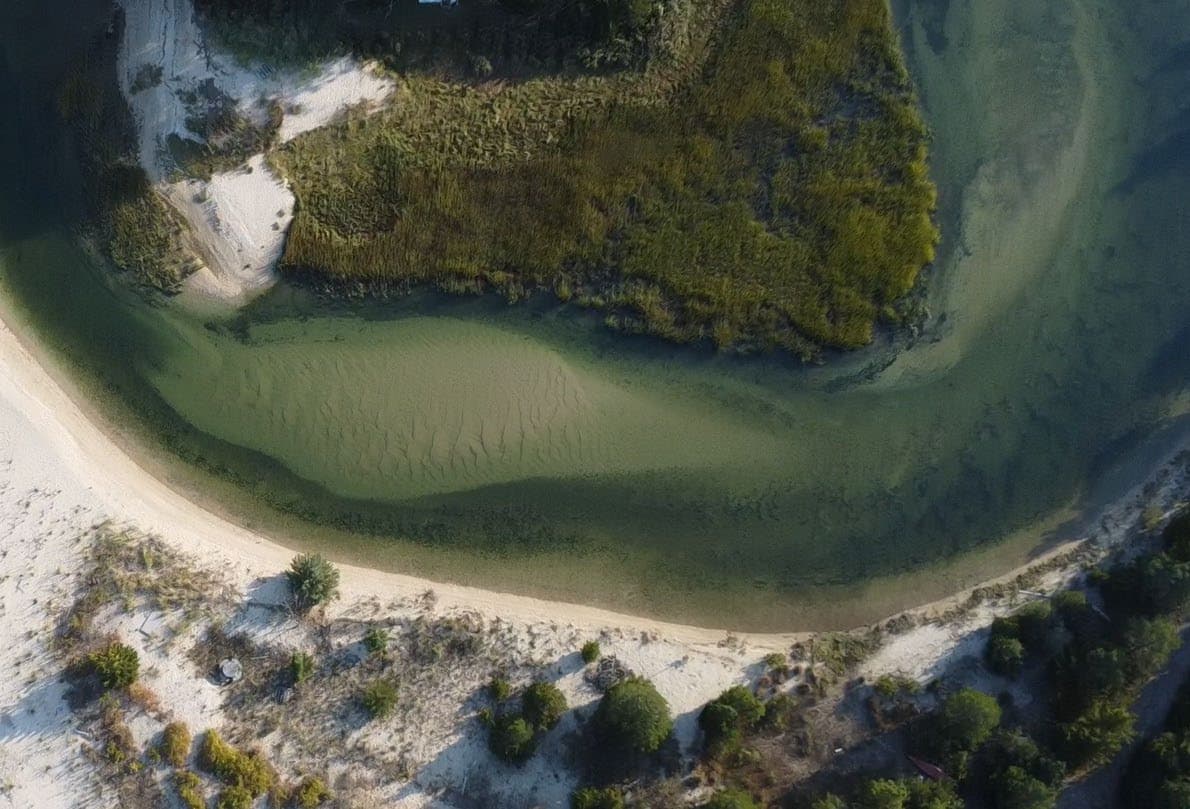
Great Meadow Creek — drone photography, April 2026
The Asset
What the Village Already Owns
The Village of Centre Island owns 28.35 acres of tidal marsh and creek on the island's eastern shore — tax parcel SBL 28 B 209. It is classified by the National Wetlands Inventory as an Estuarine and Marine Wetland (code E2EM1P): a tidally influenced marsh with high ecological productivity, significant habitat value, and measurable flood attenuation and water-quality functions.
DEC and federal agencies recognize this classification as a priority conservation asset for coastal resilience, storm surge mitigation, and biodiversity. In plain terms: the Village is sitting on an environmental asset that most municipalities would pay millions to acquire. It already owns it.
The risk is that without a formal conservation structure, this land is vulnerable to future boards with different priorities. The proposal addresses that directly.
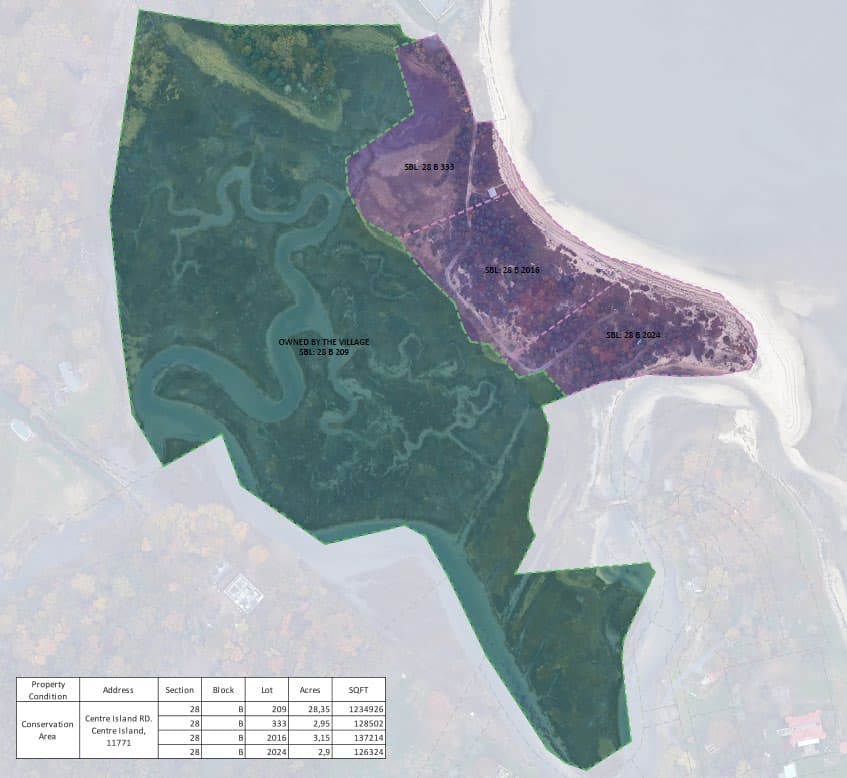
Village-owned parcel SBL 28 B 209 (green, 28.35 acres) and adjacent parcels including Jonas property SBL 28 B 333 (purple)
The Proposal
A Conservation Easement — Permanently, and on the Village's Terms
The proposal recommends the Village grant a perpetual conservation easement to a qualified third-party holder — an accredited land trust, the NY DEC, or NY State Office of Parks. This is the standard mechanism used by coastal municipalities across New York.
Village keeps full ownership
The land stays Village property. Only the right to develop or convert it is encumbered.
No public access required
New York conservation law does not require public access for this type of easement. The marsh remains off-limits to the public — no park designation, no trails, no liability.
Future boards are bound
Once recorded against the deed, the easement cannot be quietly reversed by a future board. It requires judicial review to undo.
Grant eligibility unlocked
The easement structure is specifically what state and federal wetland, resilience, and habitat programs require. Without it, most grants are ineligible.
Grant Opportunity
$1M – $3.8M Available — If the Village Acts
Once the easement is in place, the Village becomes eligible for non-acquisition, non-public-access grants across multiple state and federal programs. Estimates below reflect realistic awards for a marsh of this size, assuming competent applications and phased implementation.
Grant funds can be used for wetlands delineation, marsh health assessments, oyster reef structures, invasive species removal, tidal channel restoration, shoreline engineering, and long-term stewardship — environmental infrastructure funded largely by outside money, not Village tax dollars.
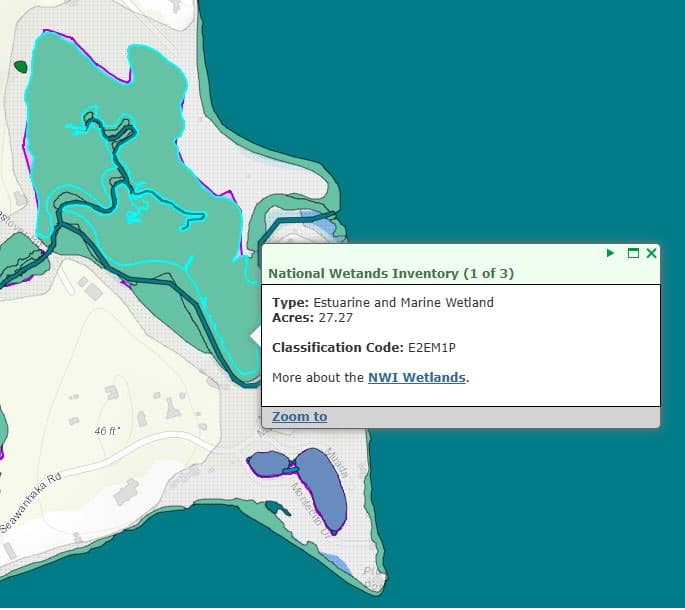
National Wetlands Inventory — E2EM1P (Estuarine and Marine Wetland), 27.27 acres. This classification is the basis for grant eligibility.
Proposed Enhancement
Oyster Restoration: Water Quality, Shoreline Protection, Additional Grant Eligibility
The proposal includes an oyster restoration program as a grant-eligible ecological enhancement. No harvesting. No commercial activity. No public access. Subtidal reef structures placed adjacent to the conserved marsh for measurable environmental benefit:
- —Oysters filter nitrogen, particulates, and sediments — directly improving water quality in the surrounding harbor
- —Reef structures reduce wave energy and protect marsh edges from undercutting and erosion
- —Habitat creation for fish, crustaceans, and invertebrates strengthens grant scoring for biodiversity programs
- —Explicitly recognized as eligible by NYS EPF, DEC Climate Smart Communities, NOAA, and EPA estuary programs
Addendum — Jonas Property
A Gateway to the Creek: The Jonas Property Opportunity
Adjacent to the Village-owned marsh sits a 2.95-acre parcel (SBL 28 B 333) listed at $899,000 for an extended period. Based on market conditions and the duration of the listing, acquisition through negotiation for approximately $500,000 is realistic.
With a modest capital improvement budget, this parcel could become something Centre Island has never had: a controlled, Village-managed access point to Great Meadow Creek — not a public park, but a resident amenity operated entirely on the Village's terms.
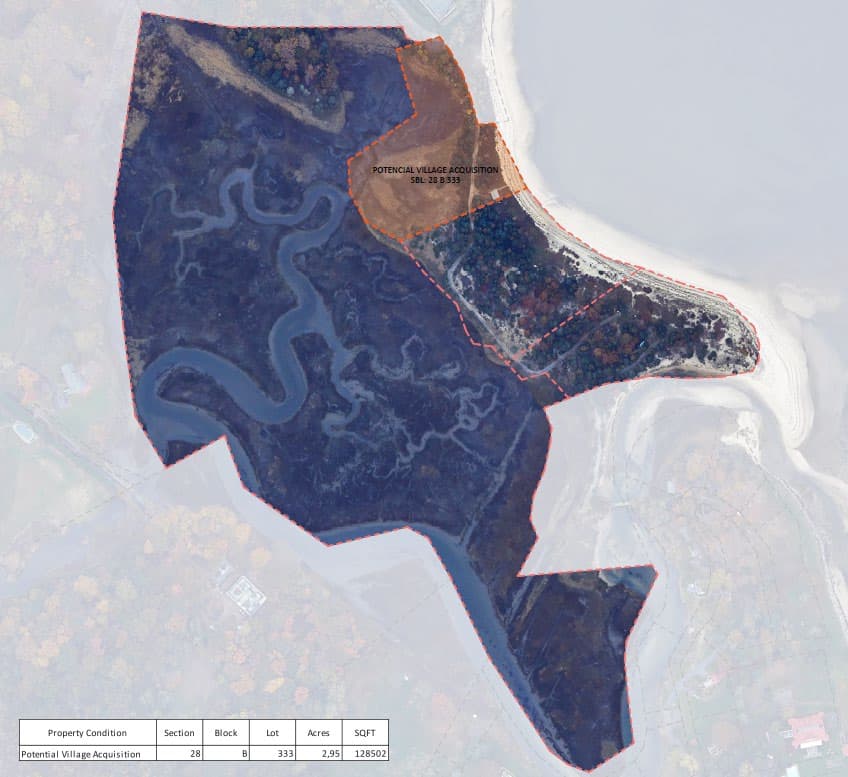
Jonas parcel SBL 28 B 333 (2.95 acres, highlighted) identified as "Potential Village Acquisition" in the January 2026 proposal
Kayak Launch
A small rack system giving residents access to Great Meadow Creek without disturbing the marsh.
Wildlife Observation
Bench seating for passive birdwatching and creek observation — the kind of amenity residents have wanted for years.
Picnic Pavilion
A modest open-air patio for stewardship gatherings and quiet community use. Not a park. Not a public beach.
Changing Room
Reuse of the existing structure as a changing facility for beach access — no new construction required.
Bike Access
Secure racks to encourage non-vehicular access and reduce parking demand at the entry point.
Grant Competitiveness
Acquiring the Jonas parcel as a conservation gateway strengthens the Village's eligibility for system-wide coastal grants.
The financial case: Acquisition at ~$500K, combined with the conservation easement structure on the adjacent Village-owned marsh, would substantially strengthen the Village's competitiveness for system-wide coastal grants — potentially recovering acquisition costs many times over in outside funding while delivering a permanent community benefit.
Status
What Happened Next
The proposal was submitted to the Board of Trustees on January 27, 2026. As of April 2026, the Board has not issued a public response, adopted any portion of the conservation framework, or advanced toward a conservation easement for the marsh.
The Jonas property remains listed. The grant windows are open. The marsh remains without permanent protection.